

 admin

Comparing Apples to Oranges: The Physics of the Nile, the Red Sea, and the Urgent Imperative of Border Demarcation
ANFET- Editorial-November 27, 2026
As military forces once again mass along the Eritrean-Ethiopian frontier—specifically around the scarred and symbolic flashpoint of Badme—the Horn of Africa finds itself staring down a familiar and perilous precipice.¹ Reports of Israeli military advisers urging sustained aerial campaigns in northern Ethiopia,² alongside investigative findings documenting Rapid Support Forces (RSF) training facilities inside Ethiopian territory,³ have injected volatile external currents into an already fragile security landscape. Yet at the very moment when statesmanship, restraint, and adherence to international law are most urgently required, rhetoric from Addis Ababa has increasingly sought to bend both international law and natural physics.
Addressing Ethiopia’s House of Peoples’ Representatives on Thursday, November 26, 2026, Prime Minister Abiy Ahmed framed his government’s maritime ambitions through a striking hydrological comparison, arguing before lawmakers that *”a country that shares its freshwater with all neighbours cannot be denied access to the Red Sea’s salty water.”*⁴ Elsewhere in the same address, he likened Ethiopia’s pursuit of sea access to the Abbay (Blue Nile) River flowing unimpeded from Lake Tana toward Sudan, warning that attempting to block what is inevitable harms those who try.⁵ In diplomatic, legal, and physical terms, this is a textbook case of comparing apples to oranges—an intellectually seductive false equivalence that collapses the moment one examines basic geography and hydrology.

Gravity, Hydrology, and the False Analogy of Flow
In natural physics, water obeys gravity, not political rhetoric. The Blue Nile (Abbay) originates in the Ethiopian highlands at Lake Tana and flows strictly downhill—north-northwest across the Sudanese plains to Khartoum, where it joins the White Nile and continues northward into Egypt and the Mediterranean Sea. Because gravity pulls freshwater from higher elevation to lower elevation along a continuous river channel, attempting to artificially stop or dam the downstream flow of a river is a physical intervention against gravity’s natural course—which is precisely why transboundary river basins require cooperative treaties and equitable sharing among riparian states.
The Red Sea, by contrast, is not a river flowing downhill out of the Ethiopian highlands. It is a deep, enclosed saltwater marine basin—a tectonic rift valley lying at sea level, separated from Ethiopia’s interior plateau by the steep escarpments of the Great Rift Valley and bordered by sovereign coastal states. No river flows from Addis Ababa into the Red Sea; the Awash River itself terminates inland in the Afar Depression without ever reaching the coast. Invoking the downward gravitational “flow” of the Blue Nile to justify a landlocked highland state’s claim to an adjacent nation’s saltwater coastline turns natural physics upside down.
International law reflects this exact physical reality. Under international water law, riparian states share rights and obligations over a moving transboundary watercourse. Under the United Nations Convention on the Law of the Sea (UNCLOS) and settled international boundaries, however, coastal waters belong to littoral states. A landlocked nation’s desire for port access—however understandable as an economic aspiration—does not confer an inherent historical, moral, or physical entitlement to another sovereign state’s shoreline. Transit and port access are commercial agreements negotiated between sovereign equals; they are never unilateral rights to be extracted through pressure, rhetorical coercion, or military force.
Even more revealing is the contradiction embedded within Prime Minister Abiy’s own parliamentary remarks. In one breath, he assured lawmakers: *”Now they say, ‘Ethiopia is going to invade Eritrea, Ethiopia will wage an invasion for the Red Sea’ – we will not wage an invasion. Invasion is not needed; we want it peacefully and through dialogue.”*⁶ In the very next breath, however, he delivered an unmistakable ultimatum to Asmara, warning that if Eritrea’s ruling party fails to change course, “Eritrea will bear the consequences”—and threatened that *”the destruction will fall upon Eritrea.”*⁷ Peace proposals paired with threats of destruction are not genuine diplomacy; they are coercive bargaining under the shadow of force.
The Shadow of Badme and Proxy Entanglements
When flawed analogies are paired with military mobilization, history warns us to pay close attention. Following the severing of diplomatic ties between Addis Ababa and Asmara in October 2026 and the outbreak of renewed fighting in Tigray, conflict monitors and intelligence reports have documented Ethiopian airstrikes near Badme, Shambuko, and Tserona, alongside troop buildups along the frontier.⁸ For Eritreans and Ethiopians alike, Badme is not an abstract talking point—it is a solemn reminder of a devastating border war that claimed tens of thousands of lives and was legally resolved nearly a quarter-century ago.
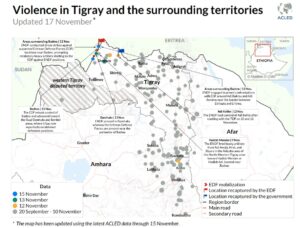
Equally alarming is the widening web of external military entanglements across the Horn. Reports have highlighted the presence of Israeli military advisers in Addis Ababa backing intensified drone campaigns in the north following Israel’s public diplomatic endorsement of Ethiopia’s Red Sea access push,⁹ while regional intelligence assessments have documented externally funded training camps inside Ethiopia supporting Mohamed Hamdan Dagalo’s (Hemedti’s) Rapid Support Forces (RSF).¹⁰ History across the Horn of Africa has proven time and again that outsourcing domestic and regional disputes to foreign military advisers and entangled proxy militias never produces durable security. Instead, it turns borderlands into tinderboxes where a single miscalculation can ignite a multi-front conflagration that neither Asmara nor Addis Ababa can contain.
Accountability on Both Sides of the Border
At ANFET Media Network, our editorial mission is rooted in advancing freedoms, truth, and democratic transformation for Eritrea and the wider region. Principled journalism requires rejecting reckless irredentism and war-mongering wherever they originate—without falling into blind apologetics for authoritarian governance at home.
The Eritrean people have endured decades of militarization, indefinite national service, and the suspension of constitutional freedoms under an unaccountable regime in Asmara that has long exploited external threats to justify internal repression. Precisely because Eritreans know the catastrophic human cost of endless war, we stand unequivocally against any external doctrine that threatens Eritrea’s territorial integrity, hard-won independence, or Red Sea sovereignty—while simultaneously insisting that Eritrea’s lasting security lies in constitutional democracy, the rule of law, and accountable governance.

The Only Viable Path Forward: Stop the War and Demarcate the Border
Ultimately, there is no military solution to the crisis engulfing the Eritrean-Ethiopian frontier, nor can rhetorical analogies rewrite geography or international law. The only credible, durable solution is an immediate cessation of all military hostilities, the withdrawal of troops and proxy militias from the borderlands, and the swift, unconditional delimitation and physical demarcation of the border in strict accordance with the Algiers Agreement of December 12, 2000, and the final and binding April 13, 2002 decision of the Eritrea-Ethiopia Boundary Commission (EEBC).¹¹
Once a mutually recognized, physically demarcated international boundary stands on the ground, peace, mutual trust, and normal neighborly commerce can follow. Landlocked nations around the world prosper every day through peaceful, mutually beneficial port agreements grounded in strict respect for international borders—a reality Prime Minister Abiy himself acknowledged when citing Jordan, Iraq, and Poland.¹²
Addis Ababa does not need a false analogy comparing the downhill flow of the Nile to the enclosed waters of the Red Sea to secure commercial access to global shipping lanes; it needs transparent diplomacy, full implementation of the Algiers Agreement, and immediate de-escalation around Badme. You cannot make a river flow uphill into a sea through rhetoric—and the peoples of the Horn of Africa cannot afford another war built on comparing apples to oranges.
Footnotes & Source References:
UK House of Commons Library Research Briefing (CBP-12313): Conflicts in Ethiopia and Sudan Highlights Risks of Wider Regional Instability (Nov 24, 2026).
DNE Africa & Regional War Briefings: Ethiopia’s New Rebel Alliance, Explained (Aug 21, 2026) and Ethiopia War Update (Nov 24, 2026).
EEPA Situation Report, Horn of Africa, No. 707 (Feb 26/27, 2026).
Fana Media Corporation (FBC / Eth TV): A Country That Shares Its Freshwater with All Neighbours Cannot Be Denied Access to the Red Sea’s Salty Water (Nov 27, 2026).
Borkena News: Abiy Ahmed Says Ethiopia Will Not Invade Eritrea, Warns Against Escalation Over Red Sea (Nov 26, 2026).
People Daily: Ethiopia Lost Its Sea Access in 1993: Why Abiy Ahmed Wants It Back (Nov 27, 2026).
Ethiopia Observer & Somalia Today: Abiy Warns Eritrea of Consequences If It Fails to Change Course (Nov 27, 2026).
Africa Confidential: Abiy Draws a Line at Assab as Badme Flares (Nov 27, 2026).
The Media Line: Ethiopian-Eritrean Fighting Raises Fears of Wider War as Egypt Builds Red Sea Alliance (Oct 9, 2026).
Critical Threats Project (AEI): Military Buildup in Northern Ethiopia: Africa File (Feb 12, 2026).
Algiers Peace Agreement (Dec 12, 2000) & Eritrea-Ethiopia Boundary Commission (EEBC) Delimitation Decision (Apr 13, 2002).
Addis Standard: ‘Stop Arming Ethiopia’s Enemies’: Abiy Tells Eritrea, Says Addis Abeba Seeks Red Sea Access Through Dialogue (Nov 26, 2026).
Addis Standard: ‘Stop Arming Ethiopia’s Enemies’: Abiy Tells Eritrea, Says Addis Abeba Seeks Red Sea Access Through Dialogue (Nov 26, 2026).
Fana Media Corporation (FBC / Eth TV): A Country That Shares Its Freshwater with All Neighbours Cannot Be Denied Access to the Red Sea’s Salty Water (Nov 27, 2026).
Blue Nile Falls, on the Blue Nile River, Ethiopia-Source-Encyclopedia Britanica.