
 admin
admin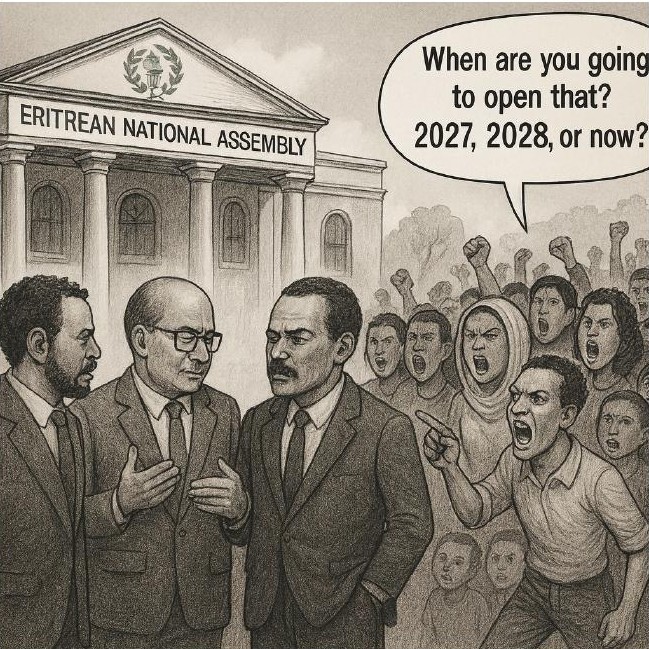
The Third National Congress of the Eritrean National Council for Democratic Change (ENCDC) has concluded with a communiqué that has already generated significant discussion across Eritrean political circles. For those committed to building a unified national platform capable of confronting authoritarianism and guiding Eritrea toward democratic transition, this document represents both progress and unfinished business.
The Congress’s renewed emphasis on unity, pluralism, and the rejection of sectarian and regional divisions is a welcome development. These principles are not abstract ideals; they are the foundation upon which any credible national umbrella must be built. The communiqué’s call for a “comprehensive national framework” based on a shared minimum program aligns directly with the long-standing vision of forming a single, inclusive National Assembly that brings together ENCDC, EPF, ECDC, and independent civic actors. In this regard, ENCDC’s language reflects a political maturity that has been long overdue.
Equally important is the Congress’s acknowledgment of fragmentation within the resistance camp. For years, Eritrean political organizations have suffered from disunity, parallel structures, and the absence of a unified strategic vision. The fact that ENCDC openly recognizes these weaknesses is a positive step. The approval of documents on the transitional phase and democratic transition further suggests that ENCDC is strengthening its institutional backbone and preparing itself for a more responsible role in national affairs.
However, the communiqué also exposes gaps that cannot be ignored. While it speaks broadly of political forces and national initiatives, it avoids naming EPF or ECDC — the very partners with whom ENCDC must collaborate to build a unified national platform. At a moment when clarity would strengthen confidence, this omission introduces ambiguity. Similarly, the Congress claims to have adopted mechanisms to address internal divisions, yet offers no details. Without transparency, it is difficult for partners to assess whether these reforms will support or hinder broader unification efforts.
More concerning is the subtle framing of ENCDC as the natural national umbrella, implicitly positioning other organizations as potential joiners rather than equal partners. Confidence is important, but unity cannot be built on assumptions of hierarchy. It requires shared ownership, mutual respect, and a willingness to confront past missteps honestly.
This is where the communiqué’s silence becomes problematic. When ENCDC withdrew from the EPF at a critical moment — while chairing the EPF and leading preparations for a broad National Assembly — it assured its partners that the move was temporary. EPF honored that assurance and waited patiently for nearly two years, keeping the unity framework open and expecting ENCDC’s return. Yet the communiqué offers no acknowledgment of this history, no reflection on the political cost of that withdrawal, and no indication that ENCDC intends to re-engage with the unity process it once helped lead. This omission risks leaving unresolved tensions at a time when rebuilding trust is essential.
The tone of the communiqué also suggests that ENCDC is prioritizing internal consolidation before engaging in external unity efforts. While internal reform is necessary, it cannot become an excuse for delaying the broader national project. Eritrea’s political landscape does not have the luxury of time. The absence of a timeline or roadmap for unity reinforces the concern that ENCDC may be moving cautiously at a moment that demands decisive collective action.
Despite these shortcomings, the communiqué still represents a meaningful step forward. It signals political alignment with the principles of unity, national responsibility, and democratic transition. It reflects a more mature institutional posture and a willingness to confront some of the challenges that have hindered the struggle. Most importantly, it opens a window of opportunity — one that must not be wasted.
For those committed to building a single, inclusive National Assembly, the path ahead is clear. Encouraging language must now be translated into concrete commitments. Principles must become structures. Aspirations must become timelines. And unity must be pursued not as a slogan, but as a shared national obligation.
ANFET believes that Eritrea’s future will not be shaped by fragmented efforts or parallel initiatives. It will be shaped by a collective national will — one that brings together all forces committed to justice, democracy, and the rule of law. The ENCDC’s Third Congress has taken a step in that direction. The next steps must be taken together, with honesty, courage, and a renewed commitment to the unity our people deserve.