
 admin
admin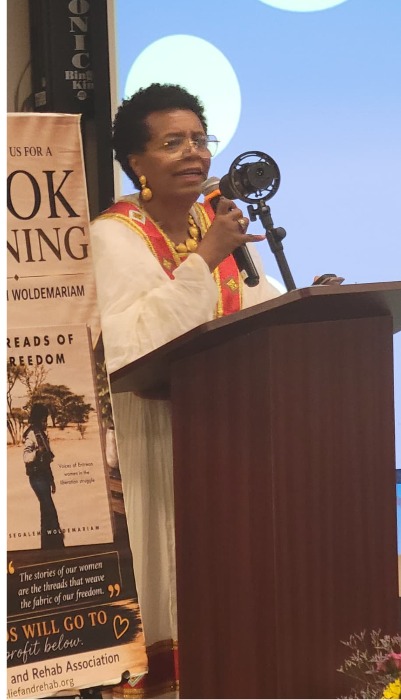
Threads of Freedom: A Testament to Eritrean Women Who Carried the Nation
ANFET Editorial
June 28, 2026
On June 27, 2026, inside the gathering hall of the Chino Senior Center in Chino, California, a powerful and necessary voice stepped boldly into the public square. Threads of Freedom, the English-language testimony of Eritrean women freedom fighters written by Tsegalem Woldemariam, was introduced to the world. The launch was not merely a literary event; it was a moment of national remembrance- a reclaiming of stories long buried under the dust of war, exile, and silence.
The atmosphere inside the hall made clear that this was far more than a book launch. The author stood at the podium wrapped in traditional attire, addressing an audience that reflected the diversity of America itself: Eritreans and Americans, Black, White, Asian, Hispanic, and people of all generations. Behind her, a banner declared, “The stories of our women are the threads that weave the fabric of our freedom.” On the book’s cover, a solitary freedom fighter walks across a dry, unforgiving landscape- a stark emblem of the path Eritrean women traveled for generations, often unseen, often unnamed, yet essential to the nation’s liberation.
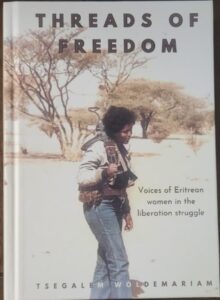
This book is their voice.
Tsegalem Woldemariam states her mission without hesitation. Threads of Freedom is written to reveal the histories and hardships of Eritrean women whose courage helped shape the liberation struggle. In its pages, twenty Eritrean women recount their lives in their own words- stories of loss, endurance, resilience, and the battles fought not only on the frontlines but also in the shadows. Among them are women who joined the struggle as early as 1965, women who endured imprisonment and torture, women who were jailed as children, women who served abroad before deployment, women who entered the struggle from Port Sudan, and women whose artistic talent carried the culture of the Kunama people to the world. Fighters, organizers, mothers, artists — they form the backbone of Eritrea’s liberation. Their stories are not footnotes; they are essential chapters of the nation’s identity.
The book traces how Eritrean women confronted social barriers, political repression, economic hardship, imprisonment, exile, torture, and the immense burden of rebuilding life after war. Through every trial, they preserved their dignity. They resisted injustice. They carried the nation at moments when the nation could not carry them. Tsegalem writes with urgency, reminding her readers, “This book is for you. Do not forget your sacrifices. Do not bury your voices.” Her warning is unmistakable: if the history of Eritrean women is not written, it will be erased from the memory of the nation.
Threads of Freedom is not only a tribute; it is a call to reclaim the narrative. For decades, the names of countless Eritrean women were omitted from official records. Their contributions were overshadowed by political agendas, their sacrifices absorbed into silence. This book breaks that silence. It restores names. It restores dignity. It restores truth.
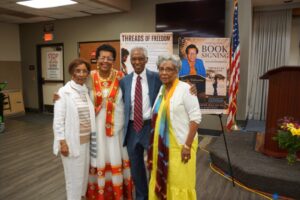
The launch event in California was hosted with warmth and pride. The images from the day show a community gathered not only to celebrate a book, but to honor a generation of women whose courage shaped Eritrea’s destiny. The first edition’s proceeds will support the Eritrean Relief and Rehabilitation Association (ERRA), a California-based charity dedicated to assisting Eritrean refugees worldwide. It is a fitting gesture, for the book itself is an act of rehabilitation-re storing what was lost, forgotten, or deliberately erased.
At a time when Eritrea’s political future remains uncertain, and when the wounds of repression continue to affect families across the diaspora, Threads of Freedom reminds us of a simple truth: a nation that forgets its women forgets its soul. The liberation struggle was not carried only by men with rifles. It was carried by women who hid fighters in their homes, walked miles to deliver food and medicine, survived imprisonment, raised children in exile, fought on the frontlines, preserved culture and identity, and rebuilt communities after war. Their stories are not optional. They are essential.
As ANFET, we recognize this book as a vital contribution to Eritrea’s collective memory. It aligns with our mission: to defend truth, uplift the oppressed, and preserve the dignity of Eritrean people everywhere. We call on all Eritreans- inside the country and across the diaspora- to read Threads of Freedom, share it, discuss it, and honor the women whose courage shaped our history.
Their stories are the threads. Our unity is the fabric. Freedom is the cloth they wove with their lives.
May their sacrifices never be forgotten.