
 admin
admin
Security Realignment and Constitutional Legitimacy: Ethiopia at a Dangerous Crossroads
ANFET Editorial – July 23, 2026
Ethiopia stands today at one of the most precarious moments in its modern history. What began in 2018 as a hopeful political transition has devolved into a complex crisis of governance, legitimacy, and regional security. The consequences are no longer confined within Ethiopia’s borders; they now shape the future of the entire Horn of Africa.
The early reforms of Prime Minister Abiy Ahmed raised expectations of democratic opening. Political prisoners were released, exiled groups returned, and Ethiopia appeared ready to confront its long-standing political contradictions. But beneath the optimism lay unresolved questions about federalism, identity, and the distribution of power. Those unresolved questions exploded in November 2020 with the war in Tigray- a conflict whose human cost, destruction, and allegations of atrocities, including genocide, have left deep scars on Ethiopia’s political fabric.
The Pretoria Agreement of 2022 halted the large-scale fighting, but it did not resolve the political crisis. Ethiopia remains divided over the future of its federal system, the legitimacy of national dialogue processes, and the role of Tigray in the country’s political order. A national dialogue that excludes a constitutionally recognized region- especially one that endured a devastating war- cannot produce a durable settlement. Ethiopia’s stability depends on whether its political actors can craft an inclusive constitutional framework that all regions recognize as legitimate.
The lessons of history are clear. The collapse of the Eritrea–Ethiopia federation in the 1950s demonstrates the danger of unilateral constitutional changes. When autonomy guarantees are eroded, political trust collapses- and conflict becomes inevitable. Eritrea’s 30-year war for independence stands as a stark reminder of what happens when federal arrangements are violated.
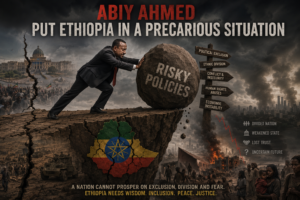
Today, Ethiopia faces similar risks. Attempts to reshape the constitutional order without broad participation threaten to deepen divisions and revive patterns of exclusion. The future of Ethiopia’s federal system cannot be decided through political dominance or military pressure. It must be negotiated through institutions that protect regional rights and ensure equitable representation.
The regional implications are equally serious. Ethiopia’s renewed rhetoric about Red Sea access has raised alarm in Eritrea and other neighboring states. Maritime access is a legitimate economic concern, but it must be pursued through diplomacy, not coercion or historical revisionism. Any suggestion of territorial claims risks destabilizing the entire region.
Sudan’s civil war, Ethiopia’s border tensions, and the long-standing Nile dispute with Egypt further complicate the security landscape. Instability in one country spills rapidly into others- through refugee flows, arms trafficking, and shifting alliances. The Horn of Africa cannot afford another cycle of confrontation driven by unilateral ambitions.
Tigray remains a central actor in Ethiopia’s future. Its political history, military experience, and geographic position make it indispensable to any national settlement. Excluding Tigray from political processes or delaying accountability for wartime atrocities will only prolong instability. Transitional justice- independent, credible, and shielded from political manipulation- is essential for national healing.
Ethiopia’s future now hinges on whether it can break its historical cycle: victory, exclusion, resentment, and renewed conflict. A sustainable political settlement must avoid the temptation to replace one dominant coalition with another. It must recognize the contributions and grievances of all communities, including those who suffered most during the recent war.
The path forward requires inclusive national dialogue, constitutional guarantees for regional autonomy, professional security reform, and economic reconstruction focused on conflict-affected regions. Ethiopia must build institutions capable of managing diversity without resorting to force.
The Horn of Africa has seen too many political transitions that promised stability but delivered fragmentation. Ethiopia’s current crossroads is not merely a domestic crisis- it is a regional turning point. The choices made now will determine whether the region moves toward cooperation and constitutional order, or toward renewed confrontation and geopolitical instability.
The stakes could not be higher. Ethiopia’s future and the future of the Horn- depends on replacing unilateralism with negotiated solutions, exclusion with participation, and confrontation with constitutional legitimacy.