
 admin
admin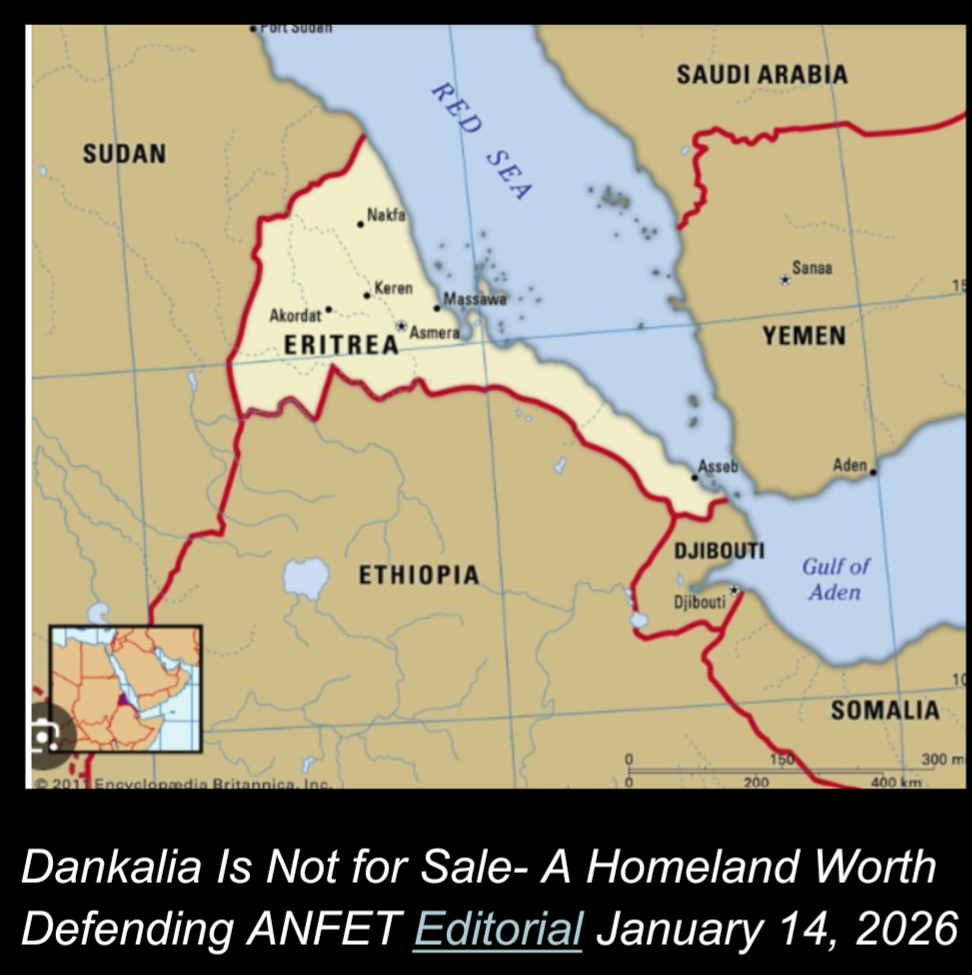
Dankalia and the Eritrean Future: Strengths and Fault Lines in the Afar Resolution
ANFET Editorial-July 10, 2026
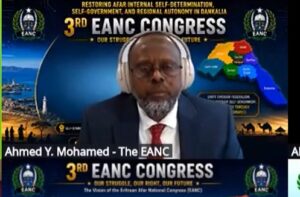
The Third Congress of the Eritrean Afar National Congress (EANC), convened on July 3–4, 2026, produced one of the most ambitious political documents in the history of Eritrean nationality movements. It is a resolution that blends Indigenous rights, federalist constitutional vision, international diplomacy, and historical legitimacy with a clarity rarely seen in Eritrean political discourse. Yet beneath its impressive architecture lie structural weaknesses, geopolitical entanglements, and strategic miscalculations that threaten to undermine both the Afar cause, Eritrea’s broader democratic struggle, and- most critically- Eritrean independence and sovereignty.
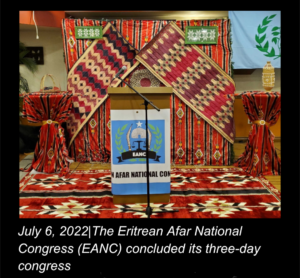
The Congress opens with a powerful assertion of legitimacy, grounded not only in modern political structures but in the historic Afar Sultanates whose participation provided cultural continuity and Indigenous authority. The resolution’s emphasis on restoring Afar self-government, protecting ancestral lands, and recognizing Dankalia as the historic homeland of the Afar Nation is articulated with constitutional sophistication. Its federalist vision- regional autonomy within a united, democratic, decentralized Eritrea- avoids separatism, aligns with international Indigenous rights law, and positions the Afar as leaders in Eritrea’s future democratic transition.
The Congress also succeeded in unifying Afar political organizations that had long been fragmented. The presence of RSADO and DPM-95, and the recognition of bilateral MoUs, signaled a new era of Afar political cohesion. Combined with strong international endorsements- from UN Special Rapporteur Mohamed Babiker, constitutional scholar Joseph Magnet, Ethiopian advisor Getachew Reda, and ENCDC chairman Mr. Nagash Osman- the Afar movement gained unprecedented diplomatic weight. The resolution’s internationalization of the Afar question, through appeals to the African Union, IGAD, the United Nations, and Western governments, reflects a sophisticated understanding of global advocacy mechanisms. Its articulation of Afar rights over coastal territories, natural resources, and the Port of Assab demonstrates a strategic awareness of the economic dimensions of federalism.
Yet these strengths are shadowed by weaknesses that cannot be ignored. The Congress’s decision to invite only ENCDC- while excluding EPF, ECDC, Yiakel, and other mainstream Eritrean civic and political organizations- was a strategic misstep that contradicted its own call for national unity. Many Eritrean groups had supported Afar international advocacy for years, but the Samara conference became a turning point. The absence of Eritrean mainstream organizations created a perception of Afar isolationism and opened the door for external actors to dominate the agenda.
The most damaging moment came during Professor Magnet’s presentation, where he outlined a controversial geopolitical blueprint: aligning the three Afar entities of Eritrea, Ethiopia, and Djibouti alongside Ethiopian military intervention, removing the Eritrean regime, occupying Asmara, drafting a constitution, and potentially establishing a non-armed Afar “Melita State” before federating Eritrea under an externally designed model. This vision, presented in a session attended and endorsed by Getachew Reda, was politically explosive. It framed the Afar movement as aligned with Ethiopian military ambitions and undermined Eritrean sovereignty. It alienated Eritrean nationalists, provided PFDJ with propaganda ammunition, and damaged Afar credibility inside Eritrea.
The involvement of Getachew Reda and the silent alignment of General Tsadqan Gebretensae- both of whom support a splintered TPLF military unit called Tigray Peace Forces (TPF) hosted in Afar Ethiopia-further complicated the picture. These actors have no interest in an independent Tigray, an independent Eritrea, or a politically strong Afar Eritrean movement. Their endorsement is not a blessing; it is a geopolitical trap. It risks transforming the Afar struggle into a proxy instrument for Medemer strategists, Red Sea power brokers, and regional actors seeking leverage over Eritrea’s transition.
The resolution’s heavy reliance on international mechanisms- AU, IGAD, UN, EU, Canada, USA- without a parallel internal strategy for national alliances, grassroots mobilization, or Eritrean civic engagement creates a dependency model rather than a sovereign political strategy. The document articulates what Afar want, but not how they will achieve it. It lacks a roadmap for federal negotiations, a strategy for engaging highland communities, a plan for rebuilding trust with Eritrean opposition, and a mechanism for protecting Afar communities from PFDJ retaliation. The regionalization of the Afar issue, especially through Ethiopian involvement, is not in Eritrea’s national interest. It serves external ambitions, not Eritrean sovereignty.
This is where ANFET’s earlier warning becomes relevant. Four years ago, when Ahmed Youssouf- President of EANC- coined the slogan “Dankalia is not for sale,” and in January 2026 ANFET responded with an editorial titled “Dankalia Is Not for Sale: A Homeland Worth Defending” That editorial reminded the Afar leadership that Dankalia is not a bargaining chip in regional geopolitics, not a corridor for external ambitions, and not a platform for foreign-designed constitutional experiments. It emphasized that Dankalia’s fate cannot be shaped in conference halls dominated by external actors, nor drafted in constitutional blueprints conceived outside Eritrea’s sovereign framework. The slogan was a declaration of dignity and ownership- a reminder that Dankalia belongs first and foremost to its people, and that its future must be defended within the context of Eritrean independence, Eritrean unity, and Eritrean national interest.
Today, that slogan must be remembered again. The direction taken at the Samara conference- where external actors dominated the conversation, where Eritrean mainstream organizations were excluded, and where geopolitical visions overshadowed national priorities- stands in contradiction to the spirit of “Dankalia is not for sale.” The Afar movement must not allow its legitimate Indigenous struggle to be transformed into a regional project serving Medemer strategists, Red Sea power brokers, or ambitious political actors seeking influence over Eritrea’s transition.
Eritrea’s future cannot be built through external intervention, military occupation, or constitutional engineering from abroad. It must be built through national dialogue, internal unity, and a sovereign democratic process that respects all Eritrean nationalities, including the Afar. Eritrea, with its tapestry of multiethnic composition, must celebrate its diversity as a source of strength and pride. Its cultures, languages, and histories are not obstacles to unity but the very foundation upon which a democratic, prosperous, and inclusive future can be built. A nation anchored in equality- where every citizen enjoys the same rights, protections, and opportunities- is the only Eritrea worthy of its people’s sacrifices. The Afar cause is just, historic, and essential to Eritrea’s democratic transformation. But its success depends on anchoring the struggle within Eritrea’s national framework, rebuilding trust with Eritrean opposition, and rejecting geopolitical agendas that compromise Eritrean sovereignty.
The Afar movement must recalibrate. It must return to the national center of gravity, strengthen alliances with Eritrean democratic forces, and articulate a federalist vision that serves not only Dankalia but the entire Eritrean nation. Only then can the Afar struggle fulfill its rightful place in the future of Eritrea- and only then will the slogan “Dankalia is not for sale” regain its full meaning as a declaration of sovereignty, dignity, and national purpose.