
 admin
admin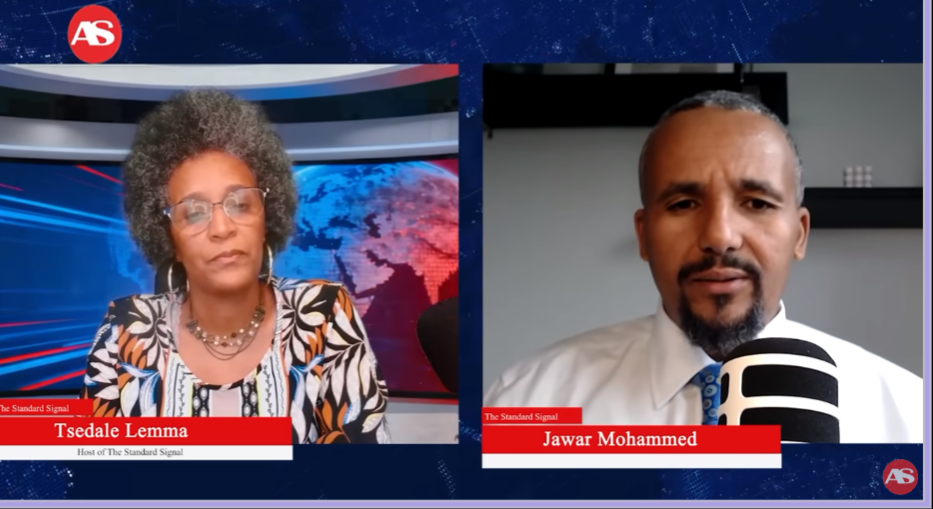
Prophetic Then, Uncertain Now: Jawar Mohammed’s Red Sea Rhetoric Revisited Against Lidetu Ayalew’s Steady Line
ANFET Editorial-October 3, 2026
The November 18, 2025 interview between Tsedale Lemma and Jawar Mohammed-available remains one of the most analytically consequential conversations on Ethiopia’s emerging Red Sea discourse. It is precisely because of its clarity and foresight that ANFET revisits it today, at a moment when Ethiopia’s political rhetoric has intensified and the regional environment has grown more fragile.
I. Revisiting Jawar’s 2025 Position: A Warning Rooted in Political Psychology
In that interview, Jawar articulated a framework that was both intellectually rigorous and politically courageous. He warned that Abiy Ahmed’s language on “sovereign access” to the Red Sea was not merely a diplomatic posture but a dangerous narrative capable of mobilizing public sentiment toward conflict. His analysis rested on three pillars: the dual nationalism strategy- Ethiopian nationalism on state television (EBC) and ethnic nationalism on Oromo media (OMN); the inflationary illusion of IMF‑driven economic policy; and the political incapacity of the current leadership to manage a crisis of this magnitude.
Jawar’s conclusion was stark: “Words can make wars.” This was not hyperbole; it was a sober assessment of how rhetoric, repetition, and state‑driven messaging can create momentum toward irreversible outcomes.
II. Lidetu Ayalew’s Steady Line: Consistency Amid Escalation
While Jawar’s 2025 position was prophetic, Lidetu Ayalew’s stance- articulated even earlier- has remained remarkably consistent. Lidetu warned that Ethiopia’s Red Sea rhetoric was structurally unsound, strategically reckless, and economically unjustifiable. He argued that Ethiopia’s internal fragmentation, governance deficits, and fiscal instability made any external military ambition not only unrealistic but self‑destructive. His consistency stands in contrast to the shifts observed today.
III. Jawar’s Present Ambiguity: A Noticeable Softening
In recent months, Jawar’s tone on the Red Sea question has become more cautious. He has not reversed his earlier warnings, but he has softened the clarity with which he once confronted the government’s narrative. This shift raises legitimate questions: Is Jawar recalibrating his position due to political pressures within the Oromo constituency? Is he responding to the evolving dynamics of Ethiopia’s fragmented opposition landscape? Or is he attempting to avoid being positioned as a counter‑nationalist voice at a time when public sentiment is volatile?
These questions do not diminish Jawar’s contributions; rather, they highlight the importance of consistency when national rhetoric edges toward militarization.
IV. The Legitimacy Question Under International Law: Jawar’s Most Critical Warning
One of the most important components of Jawar Mohammed’s 2025 interview- and one that must be emphasized today- is his clear articulation of the international legal framework governing access to the Red Sea. Jawar stated unequivocally that Ethiopia has no legal basis under international law to claim “sovereign access” to the Red Sea through Eritrean territory. His argument was grounded in established principles of sovereignty, territorial integrity, and maritime law.
He explained that historical grievances do not constitute legal claims; geographic disadvantage does not create entitlement; population size and economic pressure do not override sovereignty; and no international convention grants landlocked states the right to seize access by force. The UN Convention on the Law of the Sea (UNCLOS) does not grant landlocked states the right to forcibly obtain port access. The African Union Charter upholds territorial integrity as a foundational principle. The UN Charter prohibits threats or use of force for territorial acquisition. Ethiopia’s historical access through Eritrea ended with Eritrea’s internationally recognized independence in 1993.
In short, Jawar argued that Abiy’s narrative is political, not legal- and therefore inherently dangerous.
V. The “Simmering Rhetoric” Problem: How Repetition Creates Perceived Legitimacy
Jawar warned that when a leader repeats a legally baseless claim long enough, it can begin to sound legitimate to the public. This is the essence of his statement that “words can make wars.” Repetition creates perceived entitlement; entitlement creates public expectation; expectation creates pressure for action; pressure creates escalation; escalation creates conflict. Ethiopia has witnessed precisely this pattern over the past year: a slow, deliberate simmering of rhetoric that has normalized the idea of “access by force” in public discourse.
VI. Lidetu’s Consistency as a Counterweight to Ambiguity
Lidetu Ayalew has remained consistent on this point as well. He has repeatedly stated that Ethiopia’s Red Sea rhetoric is not grounded in law; that any attempt to pursue access through force would be illegal and catastrophic; and that the government’s narrative is a political diversion, not a strategic policy. His consistency provides a stabilizing counterweight at a time when public messaging is becoming increasingly volatile.
VII. The Role of Journalism: Tsedale Lemma’s Contribution
This editorial would be incomplete without acknowledging the role of Tsedale Lemma, whose incisive questioning made the 2025 interview a landmark moment in Ethiopian media. Her ability to probe, challenge, and clarify forced Jawar to articulate positions that remain relevant today. She confronted the economic justification head‑on, challenged the mobilizing power of nationalism, and pressed Jawar on the danger of rhetoric becoming reality. Her work exemplifies the critical role of journalism in safeguarding democratic discourse- especially when political narratives threaten to become instruments of mobilization.
VIII. Conclusion: A Call for Clarity in a Time of Uncertainty
As Ethiopia navigates a period of heightened rhetoric and regional tension, clarity from public intellectuals is essential. Jawar Mohammed’s 2025 warning remains one of the most important analyses of the Red Sea narrative. Lidetu Ayalew’s consistency provides a stabilizing counterpoint. The divergence between the two today is not a matter of political gossip; it is a matter of national consequence.
This editorial urges Ethiopia’s political actors, media institutions, and civil society to resist the gravitational pull of militarized rhetoric and to uphold the principles of sober analysis, responsible leadership, and regional peace.