
 admin
admin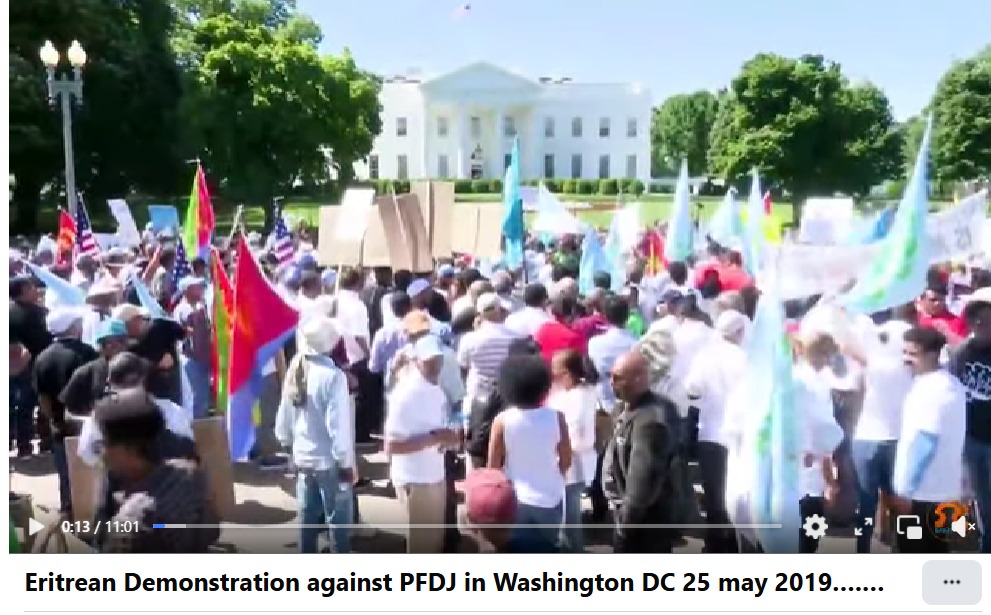
Consolidation, Minimum Program, and the Return to the Tent: A 25-Year Autopsy of Eritrean Organizational Evolution (2001– 2026)
ANFET-EDITORIAL-August 17, 2026
For nearly a quarter of a century, Eritrean political life in the diaspora has been shaped by a quiet but corrosive force: the fear of organization itself. It did not begin in Washington DC in 2021, nor with the rise of civic activism in recent years. Its roots reach back to 2001, when the PFDJ succeeded in planting a psychological reflex across diaspora communities — a reflex that equated political organization with danger, conflict, and futility. The phrase “ካብ ዘን ውድባት ርሓቑ ንየው በልወን” became a kind of social warning, repeated often enough to become instinct. Eritreans were told, implicitly and explicitly, to stay away from wedib, m’wdab, and any form of structured collective action.
This anti-organization culture shaped the next twenty-five years. After the G-15 crisis and the crackdown inside Eritrea, the diaspora entered a long period of disorientation. Political organizations weakened, not only because of internal contradictions but because the environment around them had become hostile to the very idea of organization. Civic activism rose, not because it was inherently stronger, but because it was perceived as safer- less political, less confrontational, less likely to attract suspicion. The result was a slow but steady retreat from structured political engagement.
Yet in 2008, a rare moment of hope emerged. The two blocks of the Eritrean Democratic Alliance (EDA)(Kidan) produced the National Conference in 2010, followed by the Commission, and eventually ENCDC in 2011 Awasa Congress. For a brief period, Eritreans believed that structured national politics could be revived. ENCDC represented the last serious attempt at building a unified political front. But its dominance by political organizations, and its sidelining of civic actors- especially in Europe and North America- weakened the civic base, isolated the political base, and planted the seeds of future fragmentation.
By 2018, ENCDC’s popularity had dwindled. Its internal contradictions had become too heavy to carry. Into this vacuum emerged a new wave of movements- Yiakel, Brigade N’Hamedu, and others- all built on the same foundation: rejection of Baito, rejection of ENCDC, rejection of political organizations. The advisers, the so-called “wisemen,” repeated the same message they had been spreading since 2001: stay away from organizations. Stay away from structure. Stay away from anything that resembles a political body.
Then came Medemer in Ethiopia- Abiy Ahmed’s 2018 slogan of unity and additive politics. Medemer entered Eritrea during the brief honeymoon between Asmara and Addis Ababa, carried by confusing and contradictory messages from the regime in Asmara. Those messages fed the ambition of the “Seventh King,” an ambition that now haunts him as the consequences of that moment reverberate across Eritrea’s independence and sovereignty. For Eritreans, Medemer was never merely a philosophy. It was a regional political shockwave that encouraged political disarmament. It created a false sense of stability, a belief that regional harmony had replaced the need for organized Eritrean resistance. It became an intellectual justification for avoiding organization, avoiding structure, and avoiding continuity. In doing so, it reinforced the anti-organization culture that had been growing steadily since 2001.
Following this political episode, the region was thrust into a far more destructive chapter. The multi-coalitional attack on Tigray- carried out by Ethiopian forces and foreign allies, with Eritrea playing a central role- produced deep and lasting divisions among Eritreans in the diaspora. Communities that had already been weakened by years of anti-organization culture now found themselves split between those who supported the people of Tigray and those who sided with the government of Eritrea. The war’s brutality, its regional implications, and the unprecedented involvement of Eritrean forces created a moral and political rupture that diaspora communities were unprepared to navigate. When the conflict finally ended with the Pretoria Agreement, the divisions did not vanish overnight. They lingered, disabling diaspora communities from articulating a unified national position.
Yet as the threat to Eritrea’s sovereignty re-emerged through the ambitions and rhetoric of Prime Minister Abiy Ahmed, a different kind of clarity began to take shape. The renewed danger forced Eritreans to rehabilitate their political instincts, to diverge from the paralysis of the previous years, and to refocus on the common goal of defending the nation. In confronting this external threat, Eritreans rediscovered the urgency of structured organization and the necessity of preparing for democratic change. The crisis, paradoxically, became a catalyst- pushing Eritreans to look beyond their divisions and to organize with greater seriousness, discipline, and national purpose.
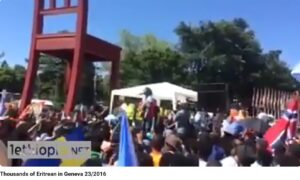
The consequences of the earlier fragmentation were visible everywhere. In 2016 for example, more than 16,000 Eritreans gathered in Geneva to condemn the regime- the largest political rally in the history of the Eritrean diaspora. It was a moment of extraordinary national energy, a demonstration that Eritreans, when called by conscience, could mobilize at a scale that rivaled national events inside the homeland. Activists and media personalities led the rally. Fourteen political leaders attended, but they were forbidden from addressing the public. This was not an accident. It was the culmination of fifteen years of anti-organization culture- a generational disconnect so deep that political leaders were treated as liabilities rather than assets. The sheer size of the crowd only underscored the tragedy: thousands of Eritreans were ready to act, yet the political class had been pushed so far to the margins that it could not speak to its own people.
Yiakel rose with promises of ground connection and flourished briefly. But it was handicapped by dominant USA Yiakel, weaker global leadership, and internal contradictions. Brigade N’Hamedu surged with equal popularity. Yiakel supported them, even loaning sixty thousand dollars for meetings and conferences.
Brigade N’Hamedu, which surged in mid-2022, was driven by genuine emotion, compassion, and a desire to reconnect the struggle with the ground. Yet its rapid rise also exposed the vulnerabilities of a movement propelled more by passion than by structure. In several cities, clashes erupted between its demonstrators and supporters of the regime. Though limited in number, these incidents generated negative media coverage and provoked reactions that weakened the movement’s public standing. What should have been a unifying civic awakening became, in part, a cautionary episode-illustrating how unstructured mobilization can be easily misinterpreted, manipulated, or turned against the very cause it seeks to advance.
Yet the familiar chorus returned: stay away from organizations. Stay away from Yiakel. Stay away from Brigade N’Hamedu. The advisers repeated the same message they had been spreading since 2001. And once again, they disappeared without taking responsibility for the fragmentation they had encouraged.
The result was predictable. Brigade N’Hamedu split into Bitweeded, and Baito Addis Ababa, and now the current EBRF. Yiakel weakened. Civic waves collapsed. Political organizations remained fragmented. The generational disconnect deepened. Eritrea’s diaspora politics became a revolving door of movements rising and falling without institutional continuity.
But in 2025–2026, something changed. With EBRF and the national crisis, Eritreans began to regain clarity. For the first time in decades, Eritreans started taking independence and sovereignty seriously. They began reaching out to each other, reconsidering the value of structured organization, and discussing minimum programs, consolidation, and mergers. The era of thirty-seven organizations is ending. The future demands mergers based on programmatic alignment, reducing thirty-seven organizations to ten or twelve, strengthening a few civic organizations, and building a unified national assembly with a minimum program and a charter.
A particularly important development emerged recently when a group of activists, operating under the name Eritrean Political Research and Information, issued a call to all political organizations to assemble around six minimum points. It was a breath of fresh air- a rare moment when civic initiative aligned with political necessity. The response was prompt, serious, and overwhelmingly positive. For the first time in many years, Eritrean organizations reacted not with hesitation or suspicion, but with readiness. It signaled that the political class, long fragmented and fatigued, was beginning to rediscover its sense of responsibility. It also demonstrated that civic actors, when they act with clarity and purpose, can help re-center the national conversation toward unity and structured action.
With the expertise of compatriots, two pillars have already emerged: the foreign diplomacy platform and the Eritrean Transitional National Repression Response Organization. These are not temporary committees. They are future branches of a national assembly- diplomacy, national security, transitional governance, civic coordination. The architecture is forming. What is missing is political will.
The era of advising from the sidelines must end. Eritrea does not need commentators, discouragers, sideline advisers, or individuals who say “do not organize.” Eritrea needs wisemen and women inside the tent, not outside it. It needs contributors, builders, people who unite, people who act, people who help forge the national assembly, people who support mergers, people who help draft the minimum program, people who stop discouraging organization, people who join hands.
The time for fragmentation is over. The time for consolidation has arrived.
Eritrea stands at a crossroads. We can continue splitting, advising from the outside, weakening movements, and disconnecting generations. Or we can consolidate, merge, build, act, create a national assembly, adopt a minimum program, and finally move toward national salvation. The choice is ours. The responsibility is ours. The moment is now.